
Pulcinella
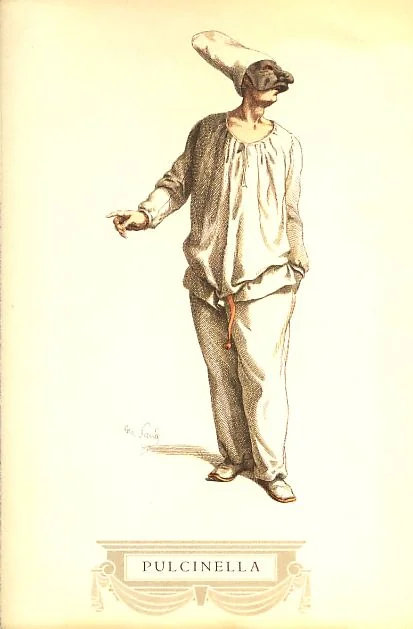
Image from Wikipedia
Image from Wikipedia
Pulcinella – the Immortal Mask of Neapolitan Folk Theater
A Character Between Coarseness, Wit, and Cultural Radiance
Pulcinella is one of the most defining figures of Southern Italian and Neapolitan folk theater. As a classic character of commedia dell’arte, he has embodied the play with contradictions for centuries: cunning and clumsy, mocking and vulnerable, popular and astonishingly adaptable. In Naples, this figure has evolved into an icon that extends far beyond the stage into art, music, and popular culture. ([de.wikipedia.org](https://de.wikipedia.org/wiki/Pulcinella?utm_source=openai))
His significance lies not only in theater history but also in his function as a cultural symbol. Treccani describes Pulcinella as an emblem of napoletanità, meaning Neapolitan identity, characterized by irony, esprit, feigned naivety, and a pragmatic philosophy of life. This complexity makes the figure still relevant for new interpretations on stage, in puppet theater, and in musical adaptations. ([treccani.it](https://www.treccani.it/enciclopedia/pulcinella/?utm_source=openai))
Origin in Folk Theater and Commedia dell’arte
Historically, Pulcinella is rooted in the theater culture of the 17th century. Various sources place him in commedia dell’arte and as a staple figure of Neapolitan puppet and folk theater, where he appears as a servant, rogue, and commentator on everyday life. The Metropolitan Museum of Art refers to Pulcinella as a character with a changeable temperament, while the World Encyclopedia of Puppetry Arts highlights the vibrant tradition of guarattelle, the Neapolitan puppet plays. ([metmuseum.org](https://www.metmuseum.org/en/essays/commedia-dellarte?utm_source=openai))
The origin of the name also belongs to the mythological context of the figure. Treccani cites several interpretations, including references to a chicken name, the beak-like nose type, or a regionally common form of family name. This very ambiguity aligns with Pulcinella’s nature: he remains somewhat ambiguous, somewhat mask-like, and therein lies his theatrical power. ([treccani.it](https://www.treccani.it/enciclopedia/pulcinella/?utm_source=openai))
Character, Gesture, and Theatrical Impact
Pulcinella is not a smooth hero, but a character full of tensions. Descriptions from theater and art history depict him as a mix of foolishness and wit, cruelty and good-naturedness, malice and imagination. This ambivalence shapes his stage presence to this day and explains why he has been reinterpreted repeatedly in different regions. ([upload.wikimedia.org](https://upload.wikimedia.org/wikipedia/commons/8/81/Italy_and_its_Inhabitants-_An_Account_of_a_Tour_in_that_Country_in_1816_and_1817%2C_in_Two_Volumes%2C_Vol._I_%28IA_dli.granth.18105%29.pdf?utm_source=openai))
Pulcinella's impact as a physical figure is particularly strong. His masking, his altered voice, his exaggerated gestures, and archetypal body language make him a colorful stage character who does not require extensive psychological explanation yet possesses immense social accuracy. In this sense, Pulcinella is also an observer of power dynamics: he mocks authority without losing contact with the people. ([treccani.it](https://www.treccani.it/enciclopedia/pulcinella/?utm_source=openai))
Pulcinella as a Cultural Symbol of Naples
Over time, Pulcinella has become much more than just a stage character. Treccani emphasizes that he has developed into a universal symbol of Neapolitan culture, embodying folk-like directness, mimetic talent, song, irony, and an unshakeable vitality. This cultural condensation explains why Pulcinella remains present today on posters, in museums, at festivals, and in museum contexts. ([treccani.it](https://www.treccani.it/enciclopedia/pulcinella/?utm_source=openai))
The art and object history also demonstrate this radiance. The Metropolitan Museum of Art documents Pulcinella in various artistic and sculptural representations, such as a pleasure-loving, folk character with food attributes. This makes it clear: Pulcinella is not just a role, but a cultural sign that exists between theater, visual art, and everyday imagination. ([metmuseum.org](https://www.metmuseum.org/en/essays/commedia-dellarte?utm_source=openai))
Musical Aftereffects and Cultural Reception
In music history, Pulcinella is particularly significant through Igor Stravinsky. The Berlin Philharmonic describes Stravinsky’s ballet Pulcinella as a work regarded today as a landmark of Neoclassicism and understood as “music about music.” In this way, the figure has secured a firm place in the concert and opera world, far beyond its theatrical origins. ([berliner-philharmoniker.de](https://www.berliner-philharmoniker.de/en/programme-notes/igor-stravinsky-pulcinella-suite-revised-version-from-1949/?utm_source=openai))
Further cultural traces reach into opera, film, and regional music traditions. The Museo e Real Bosco di Capodimonte points to a long tradition of artistic adaptations, including Giovanni Paisiello’s Pulcinella vendicato as well as cinematic and staged reinterpretations. Pulcinella thus remains a figure that constantly translates into new aesthetic spaces and reveals different facets in every era. ([capodimonte.cultura.gov.it](https://capodimonte.cultura.gov.it/mostra/napoli-napoli-di-lava-porcellana-e-musica/?utm_source=openai))
Current Relevance and Living Tradition
That Pulcinella is by no means just a museum piece is demonstrated by the ongoing presence in theater, puppet, and music programs. The World Encyclopedia of Puppetry Arts emphasizes that Pulcinella continues to be performed in Italy and has acquired national variations in various countries. Consequently, the figure is simultaneously locally rooted and internationally recognizable. ([wepa.unima.org](https://wepa.unima.org/en/pulcinella/?utm_source=openai))
Current programs and cultural historical publications also highlight Pulcinella as a vibrant reference point. The figure continues to serve as a projection surface for questions of identity, satire, social role, and artistic transformation. For this reason, Pulcinella still possesses that rare combination of awareness of tradition and timeless stage energy. ([it.wikipedia.org](https://it.wikipedia.org/wiki/Pulcinella?utm_source=openai))
Conclusion: Why Pulcinella Continues to Fascinate
Pulcinella is one of the great European mask figures because he unites comedy, social observation, and cultural memory in a single shape. His story ranges from Neapolitan folk theater through puppet stages to modern music and art reception. This adaptability makes him so fascinating: Pulcinella represents survival through transformation. Experiencing him live means seeing a figure that has laughed, mocked, and remains deeply embedded in Europe’s cultural memory for centuries. ([treccani.it](https://www.treccani.it/enciclopedia/pulcinella/?utm_source=openai))
Official Channels of Pulcinella:
- Instagram: No official profile found
- Facebook: No official profile found
- YouTube: No official profile found
- Spotify: No official profile found
- TikTok: No official profile found
Sources:
- Wikipedia – Pulcinella
- Treccani – Pulcinella
- The Metropolitan Museum of Art – Commedia dell’arte
- World Encyclopedia of Puppetry Arts – Pulcinella
- Berliner Philharmoniker – Programme Notes: Igor Stravinsky, Pulcinella
- Museo e Real Bosco di Capodimonte – Napoli, Napoli. Di lava, porcellana e musica
- OndaRock – Pulcinella: Tatekieto
- Wikipedia – Pulcinella (English Version, archived)