
Peter Casagrande
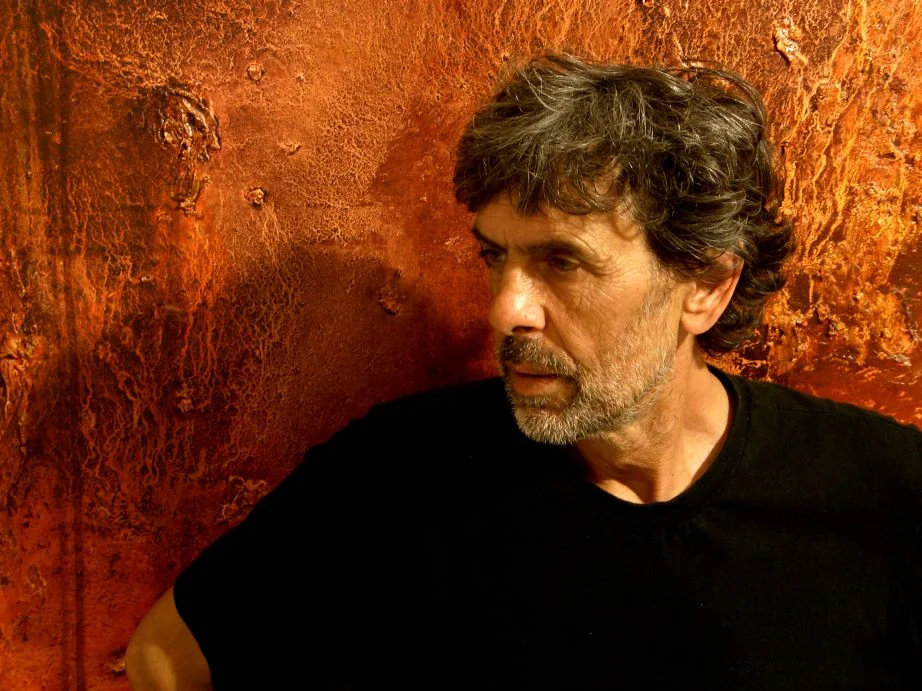
Image from Wikipedia
Image from Wikipedia
Peter Casagrande: Large-Format Painting Between Space, Color, and Energy
An Artist Who Does Not Represent Space but Creates It
Peter Casagrande, born on February 23, 1946, in Weilheim, is one of the defining voices in German painting, especially when it comes to large-format imagery, gestural freedom, and the power of color application. The artist lives and works in Maitenbeth near Munich and in Italy; his biography intertwines Bavarian origins with Italian roots and shapes the perspective on his art to this day. Casagrande's work consistently revolves around space, movement, and the emergence of the image itself. This is precisely where the fascination of his oeuvre lies: His painting does not appear decorative but rather existential, physical, and immediate.
Biographical Roots: From Weilheim through Munich and Berlin to His Own Visual Language
Casagrande's journey into art did not begin in the safety of an academic ivory tower, but in the practical realm of craftsmanship. From 1960 to 1963, he completed an apprenticeship as a sign painter before studying at significant art schools in the 1970s. Between 1970 and 1972, he studied at the Academy of Fine Arts in Munich under Rudi Tröger, then from 1972 to 1975 at the Hochschule für Bildende Künste in Berlin, returning to Munich again from 1979 to 1980. These stages mark not only his education but also a rich artistic condensation: craftsmanship transformed into a confident painterly approach.
His early struggle for orientation was particularly formative. In Berlin, Casagrande experienced a politically charged time that initially led him in different directions before he consciously returned to his roots and painting. This was followed by years in Italy, which he described as a phase of extreme solitude and concentrated work. These detours are central to his work, as they explain the internal tension between instinct and control, between risk and composition, that continues to define his images today.
The Breakthrough: Work, Scholarships, and the First Major Exhibitions
In 1983, Peter Casagrande received a scholarship from the City of Munich and the State Promotion Award from Bavaria. These accolades mark the moment when the artistic independence of his work became firmly established within the professional art world. Already in 1979, he had founded the artist collective "Maitenbeth," indicating that he never viewed art merely as an individual gesture but rather as part of a productive environment. His career developed from a combination of studio work, exhibition activities, and persistent thematic deepening.
Since the early 1980s, Casagrande has been present in galleries, art associations, and institutions with a clear art-historical profile. Early milestones include the Drazek Art Gallery in Munich and exhibitions in the Municipal Gallery in Rosenheim, and later in Berlin, Vienna, Paris, Milan, and other European art venues. This international presence points to the connectivity of his painting: It is deeply rooted in post-war German art but speaks a visual language that transcends regional categories.
The Large Format as an Artistic Principle
Encountering Peter Casagrande means encountering an uncompromising decision for large format. His works extend beyond the canvas, always considering wall, architecture, and viewing distance. Casagrande employs oversized pictorial supports that do not merely appear as a flat surface but as a space of events. In this scale, colors, layering, and trace elements develop a physical presence that almost pulls the viewer into the image.
The large format is not an external gesture for Casagrande; it is the result of his central question: How does space become visible? His paintings emerge from layers, superpositions, and gestural interventions, with underlying pictorial traces always remaining visible and entering into a dialogue with the surface. The image recalls its own emergence, sediments, fractures, and deposits. It is precisely this that creates the intensity that makes his painting so distinctive.
Painting as a Process: Gesture, Layering, and Movement of Space
Casagrande's art thrives on process. He does not work towards a completed motif but develops the image as an open movement, where spontaneous gestures merge with precise composition. Broad brushes, color gradients, thick areas of paint, and controlled interventions create a dialogue between impulse and order. His painting remains legible as painting: The process of emergence does not disappear but becomes part of the aesthetic statement.
Central to him is the idea of space as an open concept. Casagrande strips space of any objectivity and creates it solely through color, layering, and image structure. Foreground and background come into motion, the image tilts, expands, and contradicts any simple perspective. This artistic stance gives his work an almost physical tension that few pursue as consistently in contemporary German painting.
Colors, Light, and Composition: Between Intuition and Control
Although Casagrande works with powerful gestures, his painting is never merely expressive. Behind the apparent immediacy lies a high level of control, a consciousness of rhythm, weighting, and color harmony. In his images, areas can simultaneously lie in the front and back, with materiality and depth intertwining. This results in a composition that does not seem static but remains in perpetual motion.
Light also plays a decisive role in this body of work. Casagrande's images do not radiate in a decorative sense but emerge from the internal tension of the layers. The color carries the space, the darker areas structure it, and the bright accents open it up again. This results in a painting of great coherence, which, despite all its wildness, never loses sight of its central theme: the painterly invention of space.
Exhibitions, Collections, and Art Historical Presence
Peter Casagrande has been represented in numerous exhibitions over decades and is present in important collections. His works are housed in institutions and collections in Munich, Rosenheim, Genoa, Paris, and many other places. This grounding emphasizes that his work does not only function in the market or exhibition spaces but is also taken seriously from an art-historical perspective. The exhibition titles themselves repeatedly emphasize the guiding idea of his work: the large format, space, the emergence of the image.
Publications and catalogs have accompanied this development for many years. The recurring critical engagement with his painting demonstrates how constant and simultaneously adaptable his work has remained. Casagrande is not an artist of swiftly changing programs, but one committed to a long-term, concentrated deepening. His work thus gains authority because it is committed not to trends but to an inner necessity.
Cultural Influence and Artistic Stance
Casagrande's significance lies not only in individual images but in an attitude towards painting. He represents an art that takes the studio process seriously, makes physical labor visible, and perceives the image as an event. Especially in a time when much is conveyed through digital surfaces, this form of concentrated, material painting holds special relevance. It reminds us that image spaces can still be built today with color, gesture, and time.
Additionally, there is a biographical dimension: The connection between Bavarian life, Italian roots, and extended stays in Italy imparts a specific cultural tension to his work. Casagrande thinks in a European context without denying his regional foundation. His career demonstrates how a unique artistic identity can emerge from craftsmanship, existential experience, and formal consistency. This is precisely where his enduring impact on audiences, collectors, and art criticism lies.
Conclusion: An Expansive Artist Whose Work Must Be Experienced in Person
Peter Casagrande fascinates because his painting strives for more than mere surface beauty. It seeks to redefine space, make energy visible, and elevate the process of creation itself to the subject of the image. Viewers who see his works do not experience a quiet decoration but a powerful engagement with color, scale, and perception. This makes him one of the most exciting representatives of large-format, uncompromising painting with high artistic integrity.
Only in the original can the full effect of his images unfold: the size, layering, the vibrant materiality, and the relationship to the surrounding space. Anyone interested in contemporary painting, image spaces, and artistic consistency should definitely experience Peter Casagrande live. His works show how intense painting can be when it does not just illustrate but creates space.
Official Channels of Peter Casagrande:
- Instagram: No official profile found
- Facebook: No official profile found
- YouTube: No official profile found
- Spotify: No official profile found
- TikTok: No official profile found
Sources:
- Peter Casagrande – Large-Format Painting, Official Website ([peter-casagrande.de](https://www.peter-casagrande.de/))
- Peter Casagrande – Biography, Official Website ([peter-casagrande.de](https://www.peter-casagrande.de/biografie.html))
- Wikipedia: Peter Casagrande – Image and Text Source ([de.wikipedia.org](https://de.wikipedia.org/wiki/Peter_Casagrande))
- Kunstakademie Bad Reichenhall – Peter Casagrande ([kunstakademie-reichenhall.de](https://www.kunstakademie-reichenhall.de/dozenten/peter-casagrande/?utm_source=openai))
- OVB Online – “Until the Brush Falls from My Hand”: Peter Casagrande and the Large Format, 12.08.2019 ([ovb-online.de](https://www.ovb-online.de/rosenheim/wasserburg/bis-pinsel-hand-faellt-peter-casagrande-grossformat-13273336.html))