Job Fair Rosenheim: Career, Job Search & Application
Career Events & Job Fairs in Rosenheim: Your Compass for Job Searching (Outlook)
Job fairs, career evenings, and recruiting formats are regularly held in Rosenheim and the surrounding region. Here you will find out which program points you can typically expect in the future, how to prepare specifically, and how to turn conversations into real application opportunities.
Typical Schedule: Job Talk, Impulse, Workshop
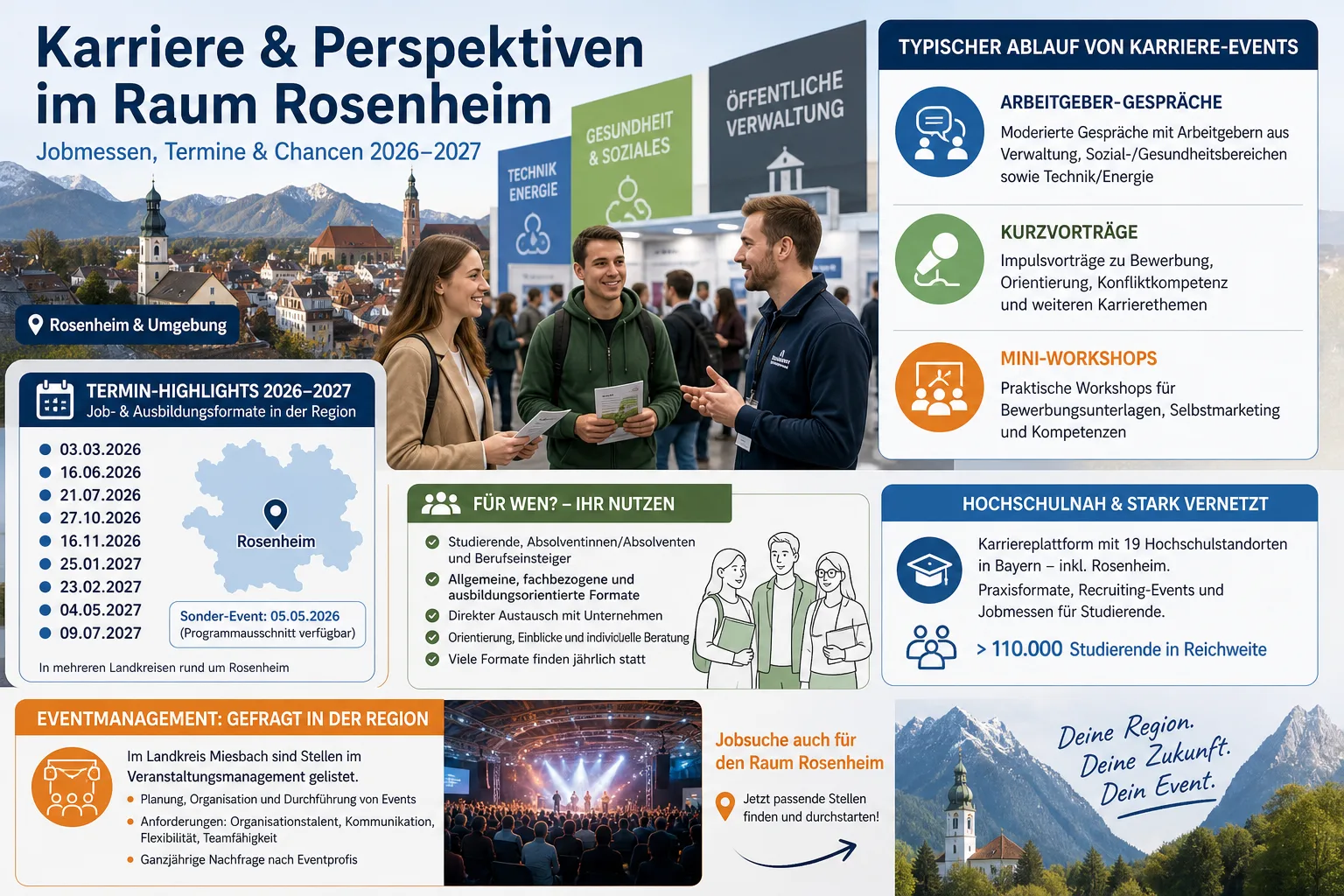
Many career events in the region follow a clear dramaturgy. This helps you use your time on site effectively and not just "walk through." You will often encounter three building blocks:
1) Moderated Job Talks with Companies
At the beginning, there are often short, moderated discussion rounds in which several employers provide insights one after another or together. This is especially useful for you if you want to compare quickly:
- Which entry paths are currently offered (internship, working student, direct entry)?
- Which profiles are being sought (fields of study, soft skills, languages)?
- How do application processes typically work (contacts, timing, documents)?
Tip: Prepare 3–5 specific questions for job talks. This way you get actionable answers that you can later directly incorporate into your application strategy.
2) Impulse Lecture on Application and Orientation
A second component is often a compact lecture (often 20–30 minutes) on topics such as:
- Channels for job searching (including regional networks and career pages)
- Resume & cover letter: priorities, structure, typical pitfalls
- Job interview: self-presentation, examples, follow-up questions
- Orientation: strengths, interests, and suitable role profiles
Plan to spend 10 minutes immediately afterwards to organize your notes: What will you implement right away (e.g., profile text, resume layout, project examples)?
3) Workshop Elements for Practical Application
Interactive parts are especially valuable because you not only receive information, but also feedback and training. Depending on the event, workshops may include, for example:
- Resume check (content, readability, relevance)
- Practice short pitch ("Who am I, what can I do, what am I looking for?")
- Interview exercises (STAR method: Situation–Task–Action–Result)
If workshops require registration, secure a spot early and bring your documents digitally (PDF) and printed.
Planning Job Fair Dates: How to Find Suitable Upcoming Events
Instead of waiting for "the one big fair," you can structure your job search in Rosenheim as a series of planned stages. In practice, this means you specifically look for upcoming dates (Rosenheim and neighboring districts) and choose events that fit your timing.
This is how you proceed in the coming weeks
- Define sources: Check the university's pages (career service/company contacts), regional economic development agencies, job portals, and the Federal Employment Agency (event notices).
- Set filters: Focus (internship, working student, entry), industry (e.g., IT, mechanical engineering, healthcare), and format (fair, career evening, workshop).
- Schedule preparation: Set a fixed date 7 days before the event for updating your resume, preparing your list of questions, and organizing your outfit/travel.
- Plan follow-up: Block out time 48 hours after the event to contact people and finalize applications.
Which "season" makes sense?
Many organizers offer their formats throughout the year. For your planning, it is less important which month an event takes place, but rather how well it fits your application window (e.g., before the start of your practical semester or several weeks before your desired start date).
Rosenheim University Location: Recruiting Around the Campus
For many future career and recruiting formats in Rosenheim, the campus plays a central role: university-related events, company presentations, practical days, and job portals are designed to bring students together with employers at an early stage.
If you (in the future) search via campus channels, pay special attention to:
- Career and job portals of the university (internship, working student, thesis, direct entry)
- Company presentations with Q&A sessions (good for understanding requirements and culture)
- Contact opportunities with recruiting teams (email, office hours, matching tools)
Advantage for you: You can directly translate conversation results into applications ("What I take away from the company presentation...", "Why this role fits my projects..."), without being vague.
Careers Behind the Scenes: Event Management in Recruiting
Tasks regularly arise around job fairs and career events that themselves offer career prospects. If you are interested in organization, communication, and coordination, event management in the context of recruiting and education can be a suitable direction.
Typical activities that may arise at future events:
- Event planning (schedule, room concept, timelines)
- Communication with companies, speakers, and service providers
- Participant management (registration, visitor guidance, information points)
- Designing workshop and lecture formats
If you want to explore this direction, use upcoming job fairs specifically: Ask organizers or exhibitors who organizes the event, which profiles are being sought, and which entry paths (internship, working student, junior position) are realistic.
How to Get the Most Out of Every Job Fair
1) Clearly Formulate Your Goal (in one sentence)
Write down a sentence before the event that you can use in conversations, e.g.: "I am looking for a working student position in data analysis starting next semester and have project experience from X." A clear sentence saves time and appears professional.
2) Questions That Really Help You
- "What tasks do you take on in the first 90 days in this role?"
- "What projects are typical, and how is success measured?"
- "Which documents help you quickly recognize my suitability?"
- "What is the next step after the conversation (contact, deadline, link)?"
3) Optimize Documents for Conversation Rather Than "Paper"
Bring your resume in a way that facilitates a conversation: 3–5 project or practical points with measurable results (e.g., "Automated process X, reduced time required"). You can add details during the conversation.
4) Follow Up Within 48 Hours
Send a short, concrete message to relevant contacts: refer to the conversation, 1–2 relevant strengths/examples, next step (application submitted or link requested). This keeps the contact "warm" and you are remembered as more than just a business card.