Events on Democracy & Contemporary History in Rosenheim
Events on Democracy & Contemporary History in Rosenheim: Orientation for Upcoming Dates
How does a city change when democracy is not only negotiated in the town hall, but also on stages, in classrooms, and at places of remembrance? In Rosenheim, such impulses arise especially when people come together at lectures, workshops, exhibitions, or dialogue formats to classify contemporary history and democratically discuss current issues.
This overview helps you to specifically find upcoming events on democracy and contemporary history in Rosenheim and the surrounding area, to classify them, and to select them appropriately – without speculation about concrete dates of individual providers.
Experience Democracy: Formats Typically Offered in Rosenheim
Based on experience, democracy events in a city like Rosenheim range from large panel discussions to small workshop formats. The common core: Participants should be able to practically comprehend democratic processes, conflicts, and values – ideally fact-based, respectfully moderated, and with room for questions.
1) Workshops and Trainings (often for schools, youth groups, and associations)
- Media and Disinformation Literacy: Recognizing false information, source verification, mechanisms of platforms.
- Hate on the Internet & Digital Civil Courage: Dealing with hate speech, reporting channels, protection of those affected, conversation strategies.
- Democratic Culture of Debate: Debating, perspective-taking, conflict resolution, rules for fair discussions.
2) Exhibitions, Tours, and Remembrance Work
For upcoming dates, it is worth looking at formats that connect local places (e.g., biographical traces, memorial signs, city history) with broader lines of German and European contemporary history. Accompanying programs such as curator-led tours, discussions, or educational materials are particularly helpful.
3) Readings, Discussions, and Lectures
Readings (non-fiction, reportage, biography, novel with contemporary historical context) and lectures (history, political science, sociology, pedagogy) are well suited if you want to focus on a topic in depth. For future events, pay attention to:
- clearly named speakers and their professional background,
- transparency about organizers/partners,
- moderation with comprehensible discussion rules.
4) Citizen Dialogues, Discussion Evenings, and Participation Formats
These formats are especially valuable when they are structured: with classification of facts, respectful moderation, time for follow-up questions, and the opportunity to hear different perspectives – without descending into mere self-promotion or agitation.
5) Simulation Games and Simulations
Simulation games (e.g., about parliament, municipality, EU, or negotiation situations) make political decision-making processes tangible. For schools and groups in Rosenheim, they can be an effective way in the future to not only "discuss" democracy, but to experience it as a system of rules, interests, and compromises.
How to Find Suitable Upcoming Events (Filters, Calendars, Tips)
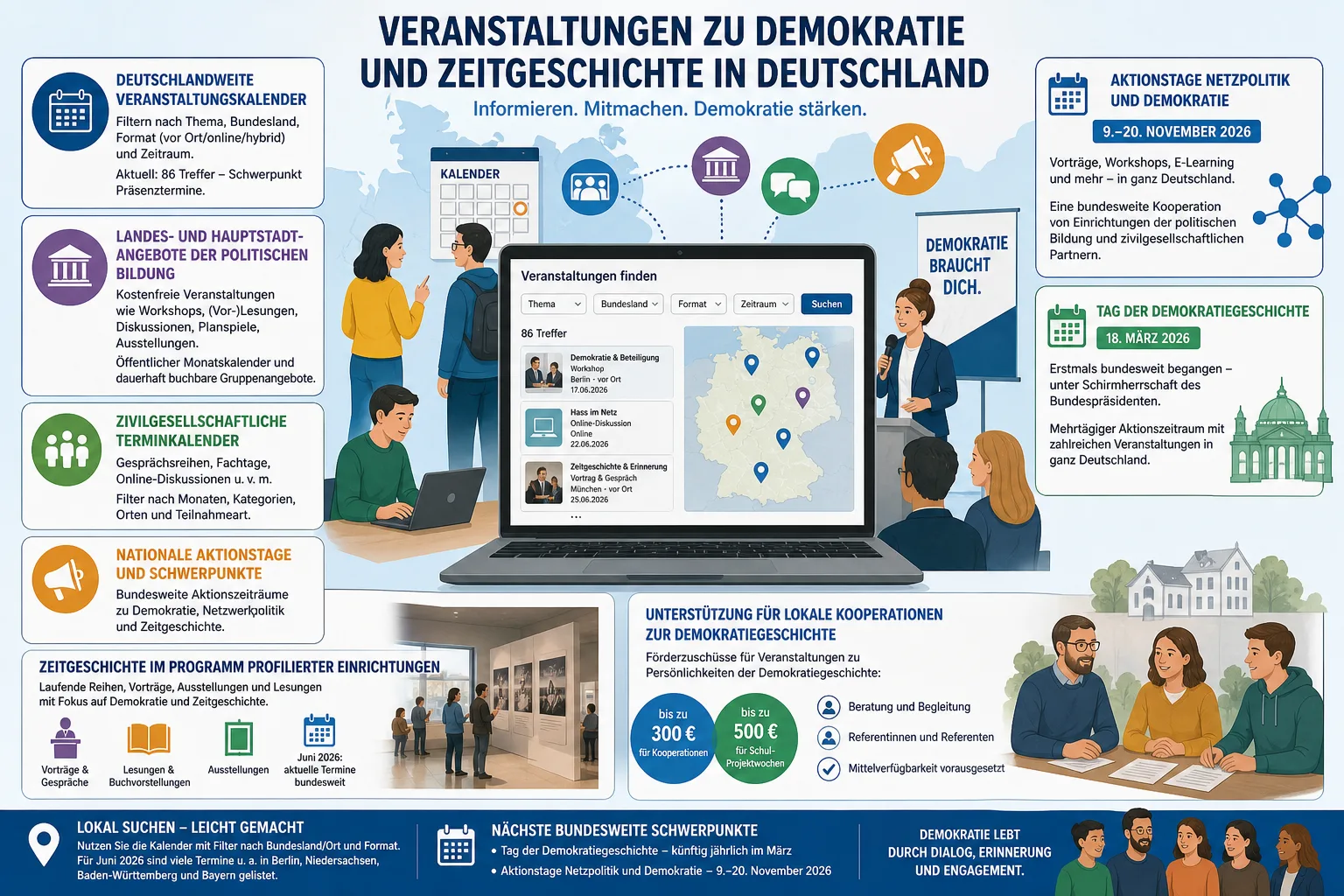
Those looking for upcoming dates on democracy and contemporary history in Rosenheim often find suitable offers more quickly by using supra-regional calendars and established organizers. Many portals allow searching by location/region, time period, topic, and format (on-site, online, hybrid).
Practical Filters That Have Proven Themselves
- Region: "Rosenheim" plus surrounding area or "Upper Bavaria"; additionally "Bavaria" for larger series.
- Format: On-site (for local networking) or online (for short-term participation and broader offerings).
- Topic: e.g., extremism prevention, antisemitism, culture of remembrance, democracy education, disinformation, net policy.
- Target Group: Youth, teachers, multipliers, general public.
- Accessibility: Information on access, language, subtitles, sign language, quiet rooms.
How to Assess Quality in Advance
- Transparency: Who is organizing? Who is funding? Who is moderating?
- Classification: Are sources named and claims made verifiable?
- Protection Concept: Are there rules for respectful interaction, especially on conflict-prone topics?
- Data Protection: For online formats: information on registration, recording, handling of data.
If you are searching as a teacher, association member, or initiative team, it can be helpful not only to check public evening events, but also bookable group offers (workshops, project days, training sessions), which can later take place as concrete dates in Rosenheim.
Commemorative and Action Days Throughout the Year (as Occasions for New Dates)
Many upcoming events do not arise "by chance" but are oriented towards recurring occasions. If you want to plan early, it is worth looking for such time windows in the calendar in advance.
March 18: Day of Democracy History
The Day of Democracy History is celebrated annually on March 18 and can serve nationwide as an occasion to make the history of democratic movements visible – for example, through exhibitions, lectures, workshops, or city walks. For Rosenheim, this offers the chance to connect local perspectives (city history, biographies, places of remembrance) with supra-regional developments.
Autumn Focus on Net Policy & Democracy
Around autumn, many organizers bundle offers on digital participation, data protection, algorithms, disinformation, and freedom of expression. For Rosenheim, such focuses are particularly relevant because they affect the everyday lives of many people: school, training, club life, local public, and municipal communication.
Other Recurring Occasions (Without Focusing on Individual Organizers)
- Anniversaries of remembrance culture, which often initiate educational programs (e.g., memorial weeks, exhibition series).
- Training periods for teachers and multipliers (often with new course starts).
- Municipal participation phases (when cities bring participation formats more into the public).
Important for planning: Not every occasion automatically leads to on-site dates. But it increases the likelihood that new events will also be announced in Rosenheim (or the immediate vicinity).
Planning Your Own Event: Cooperation, Funding, Quality
If you want to prepare your own format on democracy or contemporary history in Rosenheim, quality and reach usually increase significantly through cooperation – for example, between school, association, cultural institution, library, archive, or youth organization. For future projects, three points are crucial: funding, didactic quality, and security in the process.
Typical Building Blocks Often Supported by Funding Logic
- Cooperation events with a clear target group (e.g., youth, families, multipliers) and measurable output (discussion, exhibition, documentation, workshop results).
- Project weeks or multi-part series that deepen learning (instead of a single evening without follow-up).
- Networking & advice from established organizers who provide speakers and materials.
Quality Checklist for Upcoming Rosenheim Formats
- Goals: What should participants know or be able to do at the end?
- Methods: Interactivity, time for questions, understandable language.
- Source Work: Comprehensible evidence instead of mere assertions.
- Moderation: Clear discussion rules, handling of disruptions.
- Protection & Responsibility: Sensitive handling of discriminatory content and affectedness.
This creates a framework in which people in Rosenheim can inform themselves, discuss, and learn in the future, without individual groups being excluded or debates getting out of hand.
Why Such Events Can Shape Rosenheim in the Future
Democracy quickly seems abstract – until it becomes concrete in everyday life: when people learn to check information, when young people try out their voice in participation formats, or when contemporary history helps to classify present-day conflicts. Future events in Rosenheim can build exactly this bridge: between remembrance and future, between knowledge and action, between different worlds of life in a growing urban region.
More formats for digital public, more offers for young people, and more low-threshold dialogue spaces can contribute in the long term to Rosenheim not only being a venue, but a place where democratic competence is visibly built up.
Sources & Further Links
- Federal Agency for Civic Education (bpb) — Background, dossiers, materials, and event information (accessed 2026-06-10)
- Federal Program "Living Democracy!" — Information on funding approaches and project logic (accessed 2026-06-10)
- The Federal Government — Orientation on policy areas, initiatives, and official information (accessed 2026-06-10)
- The Federal President — Information on patronages and nationwide occasions (accessed 2026-06-10)
- Federal Office for Information Security (BSI) — Information on safe behavior online and digital resilience (accessed 2026-06-10)